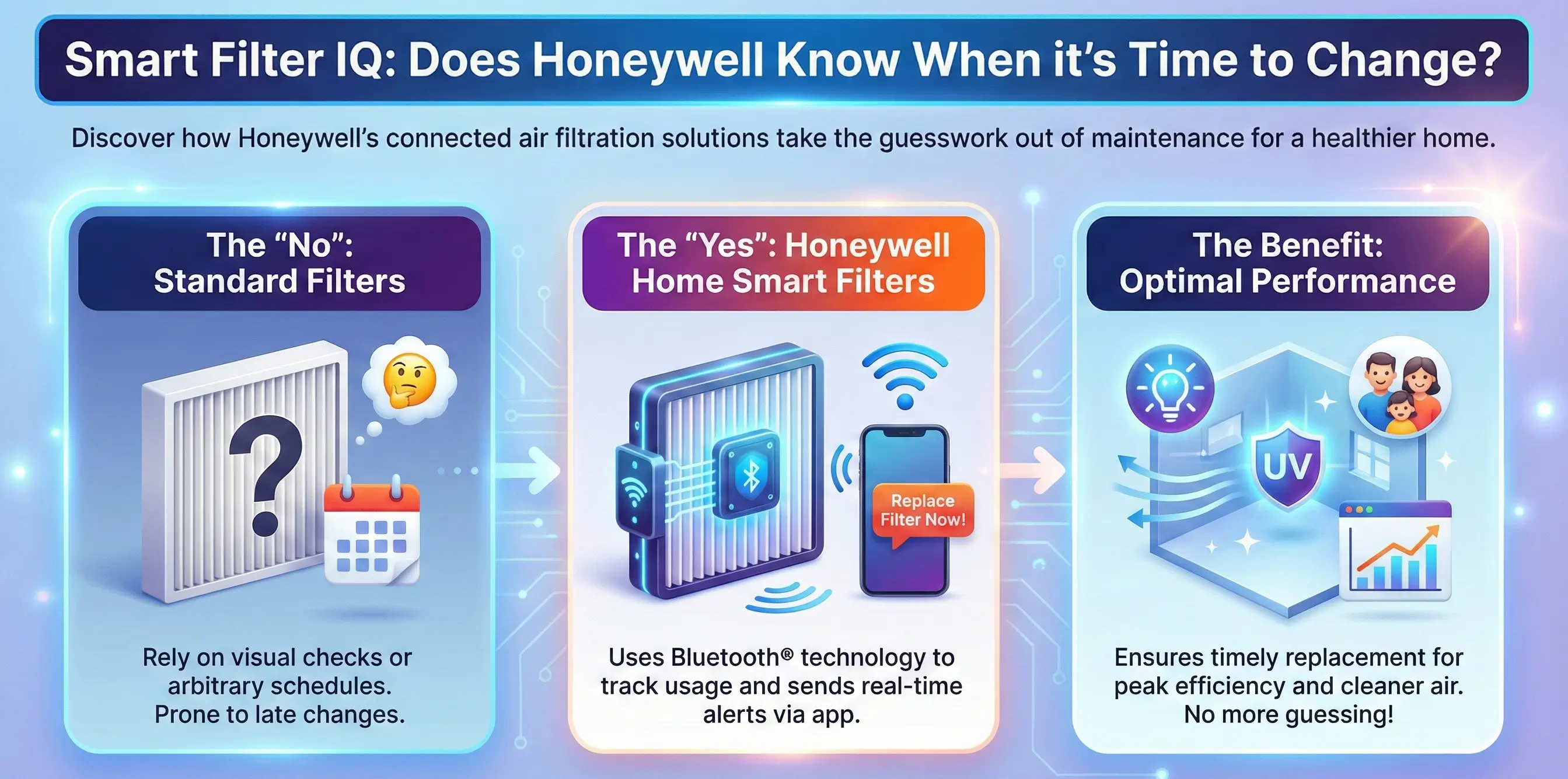
Honeywell doesn't manufacture smart filters with built-in sensors that alert you when it's time for a replacement. However, they do offer smart home solutions that monitor filter status and send reminders through connected thermostats and air quality systems.
If you came here hoping to find a Honeywell filter that tracks its own lifespan and notifies your phone, you're not alone. Our Pembroke Pines technicians field this question weekly—especially from homeowners who've invested in UV light installations and want every component of their indoor air quality system working intelligently together.
Here's what we've learned after thousands of HVAC service calls across South Florida: the humidity and particulate levels in our region push filters harder than manufacturer timelines suggest. A "90-day" filter in Pembroke Pines often needs swapping at 60 days, which is exactly why smart monitoring matters here more than in drier climates.
In this guide, we'll break down what Honeywell actually offers, explain how their smart thermostat filter reminders work, and share the smart filter alternatives we've seen perform reliably in the homes we service. Whether you want to stick with Honeywell's ecosystem or explore third-party smart filters, you'll leave with a clear path forward. In this guide, we'll break down what Honeywell actually offers, explain how their smart thermostat filter reminders work, and share the smart filter alternatives we've seen perform reliably in the homes we service. Whether you want to stick with Honeywell's ecosystem or explore third-party smart filters, you'll leave with a clear path forward.
Quick Answers
Honeywell Filters
What they are: Standard HVAC air filters available in various sizes and MERV ratings (typically MERV 4–13) for residential heating and cooling systems.
What they're not: Smart filters with built-in sensors. Honeywell does not manufacture filters that monitor their own condition or send replacement alerts.
Smart monitoring option: Honeywell smart thermostats (T5, T6, T9 series) offer filter change reminders based on runtime hours—not actual filter saturation.
Our field-tested recommendation for South Florida:
Use MERV 11 or higher for local pollen and humidity conditions
Replace every 45–60 days, not the 90-day manufacturer suggestion
Inspect monthly regardless of thermostat reminders
Bottom line: Honeywell makes reliable filters. They don't make filters that think for themselves. In year-round cooling climates like Pembroke Pines, trust your eyes over app notifications—and replace more often than the packaging recommends.
Top Takeaways
1. Honeywell Doesn't Make True Smart Filters
Their monitoring runs through smart thermostats only
The system uses runtime calculations—not actual sensor data
It's a timer-based estimate, not real-time airflow measurement
2. Real Smart Filter Technology Exists Elsewhere
Third-party sensors measure actual filter conditions
Devices like FilterScan track pressure differentials
These tools give accurate, home-specific replacement timing
3. South Florida Demands Faster Filter Changes
"90-day" filters often need replacement at 45–60 days locally
Year-round cooling accelerates filter saturation
Our recommendation: Cut manufacturer intervals by at least 30 percent
4. The Federal Data Is Real—We See It Weekly
Clean filters reduce energy consumption by 5–15 percent
Indoor air pollution ranks among the top five health risks
Proper maintenance impacts comfort, health, and utility bills
5. Technology Helps, but Attention Matters Most
Smart tools support good habits—they don't replace them
Monthly inspections work with or without an app
The bottom line: Don't let your filter become the weak link
What Honeywell Actually Offers for Filter Monitoring
Honeywell's approach to smart filter management runs through their connected thermostat ecosystem rather than the filters themselves. Their T-series smart thermostats, including the popular T6 and T9 models, track runtime hours and send filter change reminders to the Honeywell Home app on your phone.
This system works on a timer-based calculation. The thermostat logs how many hours your system runs, estimates filter saturation based on that runtime, and pushes a notification when it hits the threshold you've set. It's a step above forgetting entirely, but it doesn't measure actual airflow restriction or particulate buildup.
In our experience servicing Pembroke Pines homes with Honeywell systems, these reminders run about two to three weeks behind what the filter actually needs in peak cooling season. The algorithm doesn't account for South Florida's pollen counts, humidity levels, or the extra strain from homes running AC nearly year-round.
How Sensor-Based Smart Filters Differ
True smart filters use pressure differential sensors or airflow monitors mounted near the filter slot. These devices measure real-time resistance as debris accumulates, giving you an accurate read on when replacement is genuinely needed—not just an estimate based on calendar days or runtime.
Brands with their smart app integration and third-party monitors take this approach. We've installed FilterScan sensors alongside UV light systems in several Pembroke Pines homes, and the data consistently shows replacement needs varying by three to six weeks depending on household factors like pets, occupancy, and nearby construction.
Why This Matters for South Florida Homeowners
Generic filter replacement timelines assume moderate climate conditions. Pembroke Pines doesn't offer moderate conditions. Between the humidity promoting microbial growth on filter media and the constant system runtime keeping air flowing through that filter, saturation happens faster here.
We've pulled filters at the 45-day mark that look worse than what manufacturers show at 90 days. When homeowners pair smart monitoring with UV light installations, they're creating a system that actually responds to local conditions rather than national averages.
Choosing the Right Monitoring Solution
If you're already in the Honeywell ecosystem with a compatible smart thermostat, their built-in reminders provide baseline awareness at no extra cost. Adjust the reminder threshold shorter than the app suggests—we recommend cutting the default interval by 30 percent for South Florida homes.
For precise monitoring that accounts for real filter conditions, aftermarket sensors deliver better accuracy. They cost more upfront but prevent both premature replacements and the efficiency losses from running clogged filters too long. Homeowners with UV light systems or whole-home air purification often find the added precision worth the investment since every component in that chain affects overall performance.
"Homeowners always ask us why their filters look so dirty before the app says to change them. The answer comes down to what that app is actually measuring—runtime hours, not real-world conditions. A Honeywell thermostat doesn't know you have three dogs, that there's construction down the street, or that South Florida humidity is accelerating microbial growth on the filter media. After 20-plus years of servicing systems across Pembroke Pines, we tell every customer the same thing: trust the filter, not the timer. When we pair smart pressure sensors with UV light installations, clients finally see what's actually happening inside their system instead of relying on guesswork from a generic algorithm."
Essential Resources for Smarter Filter Management
When our Pembroke Pines technicians recommend filter monitoring solutions, we point homeowners to the same resources we use to stay current on best practices. These seven guides come from sources we trust—and they'll help you make informed decisions about your home's air quality system.
Understanding How Filters Actually Work
The EPA's guide covers everything from MERV ratings to how different filter types capture particles. We reference this document regularly when helping homeowners choose between upgrading their existing filtration or adding smart monitoring.
Resource: EPA Guide to Air Cleaners in the Home https://www.epa.gov/indoor-air-quality-iaq/guide-air-cleaners-home
Decoding the MERV Rating System
Before investing in smart filter monitoring, you need to understand what your filter should be capturing. The EPA breaks down the MERV scale developed by ASHRAE—the same rating system we use when recommending filter upgrades for South Florida homes dealing with high humidity and particulate loads.
Resource: EPA MERV Rating Explained https://www.epa.gov/indoor-air-quality-iaq/what-merv-rating
Smart Thermostat Energy Savings and Features
ENERGY STAR's smart thermostat guide explains how certified devices—including those with filter reminders—deliver verified energy savings. We've seen homeowners cut heating and cooling costs while getting basic filter monitoring built into equipment they already planned to install.
Resource: ENERGY STAR Smart Thermostats https://www.energystar.gov/products/smart_thermostats
Choosing the Right Smart Thermostat for Your Home
Not every smart thermostat offers the same filter monitoring capabilities. ENERGY STAR's buying guide walks you through compatibility, features, and what to expect from different price points. We use this resource when helping customers decide between basic timer-based reminders and more advanced monitoring.
Resource: ENERGY STAR How to Choose a Smart Thermostat https://www.energystar.gov/products/ask-the-experts/how-choose-smart-thermostat
Honeywell's Smart Thermostat Filter Features
If you're considering Honeywell's ecosystem, their T5 product page details exactly how their filter change reminders work—runtime tracking, app notifications, and integration with their smart home platform. Understanding these limitations helped us develop better recommendations for South Florida homeowners.
Resource: Honeywell Home T5 Smart Thermostat https://www.honeywellhome.com/products/t5-smart-thermostat
Maximizing HVAC Efficiency Through Proper Maintenance
ENERGY STAR's heating and cooling efficiency guide reinforces what we tell every customer: clean filters can reduce energy consumption by up to 15 percent. This resource explains why regular filter changes—tracked by smart monitoring or otherwise—directly impact your utility bills.
Resource: ENERGY STAR Heat & Cool Efficiently https://www.energystar.gov/saveathome/heating-cooling
Technical Deep-Dive on Residential Air Cleaning
For homeowners who want the complete picture, the EPA's technical summary covers everything from UV air cleaning to advanced filtration strategies. We reference this when designing comprehensive indoor air quality systems that pair smart filter monitoring with UV light installations.
Resource: EPA Residential Air Cleaners Technical Summary (PDF) https://www.epa.gov/sites/default/files/2018-07/documents/residential_air_cleaners_-_a_technical_summary_3rd_edition.pdf
Supporting Statistics: Federal Research Confirms What We See in the Field
After decades of servicing HVAC systems across Pembroke Pines, we've learned that federal data consistently validates what our technicians observe during service calls. Here's how the research aligns with our hands-on experience.
Clean Filters Cut Energy Costs by 5–15 Percent
The U.S. Department of Energy confirms that proper filter maintenance reduces air conditioner energy consumption by 5 to 15 percent.
What we've seen in the field:
South Florida systems run harder and longer than national averages
Clogged filters create compounding efficiency losses in year-round cooling climates
Local savings typically land on the higher end of that 5–15 percent range
Customers with smart monitoring report noticeable FPL bill drops within one billing cycle
Source: U.S. Department of Energy – Energy Saver 101: Home Cooling https://www.energy.gov/energysaver/articles/energy-saver-101-home-cooling-infographic
Americans Spend 90 Percent of Their Time Indoors
The EPA reports we spend approximately 90 percent of our time indoors—a number that feels conservative for Pembroke Pines residents who stay inside under AC most of the year.
Why this matters locally:
Your filter processes the air you breathe almost constantly
Families often don't connect recurring allergy symptoms to overdue filter changes
Households with children, elderly members, or respiratory conditions face elevated risk
Smart monitoring closes the gap between "should replace" and "actually replaced"
Source: U.S. Environmental Protection Agency – Indoor Air Quality https://www.epa.gov/indoor-air-quality-iaq
88 Percent of U.S. Homes Have Air Conditioning
Department of Energy data shows 88 percent of American homes have AC, consuming 12 percent of household electricity—roughly $29 billion annually nationwide.
The South Florida reality:
Pembroke Pines AC adoption is effectively 100 percent
Our systems run year-round, not seasonally
National filter replacement guidelines don't account for constant usage
Our recommendation: Cut manufacturer intervals by 30 percent minimum
Source: U.S. Department of Energy – Air Conditioning https://www.energy.gov/energysaver/air-conditioning
Nearly Half of Home Energy Goes to Heating and Cooling
ENERGY STAR calculates that heating and cooling consume almost half the average household energy bill—more than $900 per year.
What this looks like in our service area:
Cooling dominates the equation almost exclusively in South Florida
We've seen annual cooling costs exceed $1,500 in larger or older homes
Unnoticed filter clogs cause slow efficiency bleeds over weeks or months
One customer's system struggled for months before she realized her "90-day" filter saturated at day 45
Source: ENERGY STAR – Smart Thermostats https://www.energystar.gov/products/smart_thermostats
Indoor Air Pollution Ranks Among Top Five Health Risks
The EPA's Science Advisory Board consistently ranks indoor air pollution among the top five environmental health risks nationwide.
How we apply this in the field:
Every installation addresses documented public health concerns—not just comfort
Families managing asthma or respiratory conditions prioritize accurate filter monitoring
Proper maintenance becomes a health decision, not just an equipment issue
UV light systems paired with smart monitoring create comprehensive indoor air protection
Source: U.S. Environmental Protection Agency – Why Indoor Air Quality is Important to Schools https://www.epa.gov/iaq-schools/why-indoor-air-quality-important-schools
Key Takeaways:
Federal research validates what we observe in thousands of local service calls
National statistics underestimate South Florida filter replacement needs
Smart monitoring eliminates guesswork and prevents efficiency losses
Proper filter maintenance impacts health, comfort, and monthly utility costs
Final Thought: Our Take on Smart Filter Technology After 20+ Years in the Field
The short answer: No, Honeywell doesn't make smart filters with built-in sensors that alert you when replacement is due.
Honeywell's approach runs through their smart thermostat ecosystem, using runtime calculations to estimate filter life. It's better than forgetting entirely—but it's not measuring what actually matters: real-time airflow restriction and particulate buildup.
For true smart filter monitoring, the technology exists. Just not from Honeywell directly.
Our Professional Opinion
After servicing thousands of HVAC systems across South Florida, we've developed a clear perspective: the best monitoring solution depends entirely on your specific situation.
If you're already in Honeywell's ecosystem:
Their built-in reminders provide baseline awareness at no extra cost
Understand the limitations—the system doesn't know about your pets, nearby construction, or South Florida humidity
Cut the default interval by at least 30 percent for local conditions
Treat notifications as prompts to inspect, not guarantees that replacement is due
If precision matters to your household:
Invest in aftermarket sensors that measure actual filter conditions
We install these alongside UV light systems in homes where air quality is a health priority
Our data shows replacement needs vary by 3–6 weeks depending on household factors
That variability proves the point: generic timelines don't work for everyone
If you're unsure where to start:
Check your filter monthly—regardless of app reminders
Hold it up to light
If you can't see through it clearly, replace it
No technology required
The Bigger Picture
What strikes us most about this topic isn't the technology. It's what the search for smart filter monitoring reveals about homeowner priorities.
People want confidence that:
Their system runs efficiently
Energy bills aren't inflated by neglected maintenance
Their family breathes clean air
Those concerns are valid. We see the federal statistics play out in real homes every week:
The family whose allergies improved after establishing proper filter timing
The homeowner who finally understood why her system struggled every summer
The couple who paired smart monitoring with UV light installation and noticed the difference within days
Where We Stand
Our honest opinion? Smart filter technology is helpful but not essential. What's essential is paying attention.
The homeowners with the healthiest, most efficient systems aren't necessarily those with the most advanced tools. They're the ones who treat filter maintenance as a priority rather than an afterthought.
Smart technology can support that mindset. It can't replace it.
Looking Ahead
If Honeywell eventually releases filters with built-in sensors that communicate actual saturation levels, we'll be among the first to test them locally and share what we learn.
Until then, we recommend the combination that works:
Quality filters rated for your system
Replacement intervals adjusted for South Florida realities
Monitoring solutions—smart or simple—that keep you informed
The bottom line: Your filter is the first line of defense for both your equipment and your indoor air. Whether you track it with a smartphone app, a pressure sensor, or a note on your calendar, the goal remains the same.
Don't let it become the weak link in your system.
FAQ on "Honeywell Filters"
Q: Does Honeywell make smart filters that notify you when to change them?
A: No. Honeywell does not manufacture filters with built-in sensors.
How their system actually works:
Filter monitoring runs through smart thermostats only
The thermostat tracks runtime hours to estimate replacement timing
It does not measure actual filter saturation or airflow restriction
What we've observed locally:
These estimates run 2–3 weeks behind actual filter needs
The system can't account for pets, dust, or humidity levels
South Florida conditions accelerate buildup faster than algorithms predict
Q: What MERV rating should I use with my Honeywell HVAC system?
A: Most Honeywell systems accommodate MERV 8–13 filters. We recommend MERV 11 or higher for South Florida homes.
Key considerations:
Higher MERV ratings capture more pollen and humidity-related particulates
Higher ratings also create more airflow resistance
Older systems may struggle with MERV 13 filters
Before upgrading:
Check your equipment specifications
Confirm your blower motor can handle increased restriction
Consult an HVAC technician if unsure
Q: How often should I change my Honeywell filter in Florida?
A: Every 45–60 days during peak cooling season. Manufacturer guidelines of 60–90 days assume moderate climates—not year-round South Florida usage.
What we see in the field:
45-day-old filters often look worse than manufacturers picture at 90 days
Year-round cooling accelerates saturation significantly
High humidity promotes faster particulate buildup
Our recommended schedule:
Inspect monthly regardless of reminders
Replace every 45–60 days minimum
Check more frequently with pets, nearby construction, or continuous operation
Q: Can I use non-Honeywell filters in my Honeywell thermostat system?
A: Yes. Any properly sized filter works with Honeywell thermostats.
Why brand matching doesn't matter:
Thermostats track runtime hours only
They don't communicate with the filter itself
We install various brands based on home-specific needs
What actually matters:
Correct filter dimensions
Appropriate MERV rating for your system
Airflow compatibility with your equipment
Q: Are Honeywell's smart thermostat filter reminders accurate?
A: They are helpful but not precise. Reminders estimate replacement based on runtime—not actual filter conditions.
What the algorithm misses:
Pet dander levels in your home
Local air quality and construction activity
South Florida humidity promoting microbial growth on filter media
Our recommendation:
Treat reminders as inspection prompts, not replacement guarantees
Visually check filters when notifications appear
Consider aftermarket pressure sensors for real-time accuracy
For precise monitoring:
Pressure differential sensors measure actual airflow restriction
Data reflects your specific home conditions
Replacement timing becomes accurate rather than estimated
Learn more about HVAC Care from one of our HVAC solutions branches…
Filterbuy HVAC Solutions - Miami FL - Air Conditioning Service
1300 S Miami Ave Apt 4806 Miami FL 33130
(305) 306-5027
https://maps.app.goo.gl/Ci1vrL596LhvXKU79