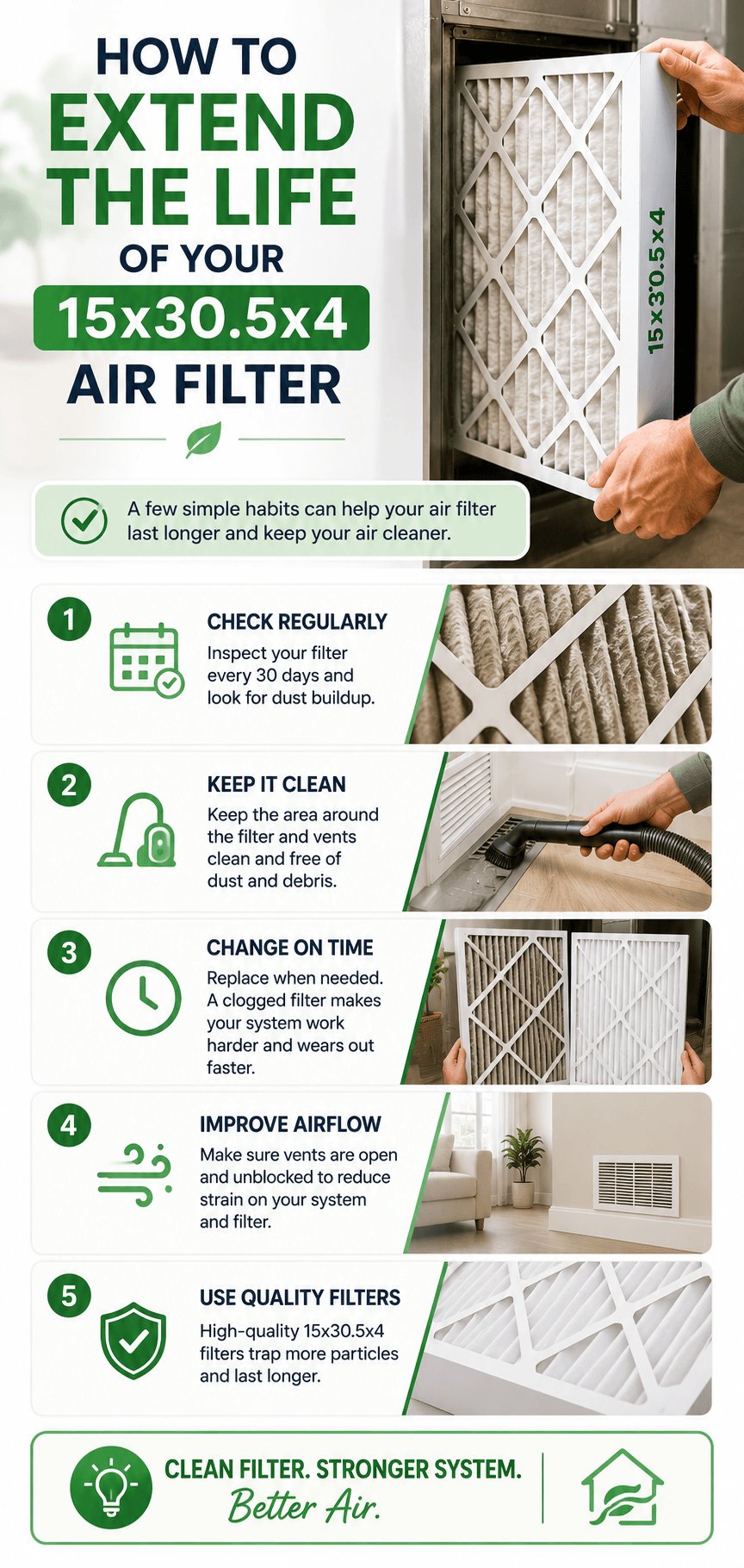
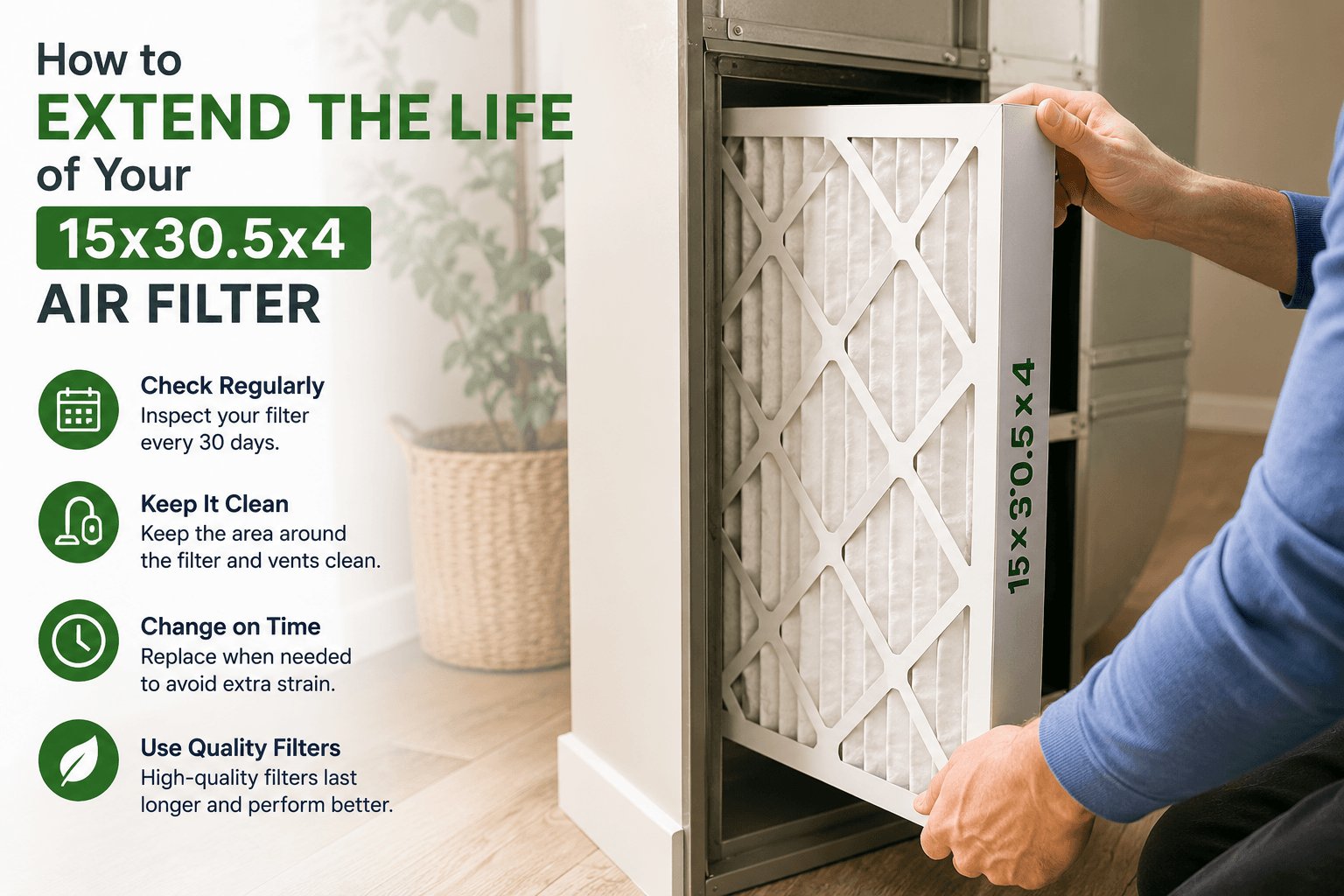
Pull a spent 15x30.5x4 out of a return that has been fighting it, and the pleats tell you the whole story. A gray crust sits unevenly across the media. The cardboard frame is bowed from pressure it was never built to carry. I have handled plenty of these filters that quit months ahead of schedule, and the filter itself was rarely the culprit. The air moving around it was. A four-inch pleat holds enough media to last a long time, but only when the system and your habits give it a fair shot. That is the part most people miss, and the part you actually control. I keep a quality pleated 15x30.5x4 air filter on the shelf before the old one gives out, then let steady habits and good airflow carry it the rest of the way. Here is how I make one last.
TL;DR Quick Answers
15x30.5x4 Air Filters
A 15x30.5x4 is a four-inch deep-pleat HVAC filter sized to its slot, not its exact measurements. The extra media depth lets it run three to six months and handle MERV 8 through 13 without choking airflow, far longer than a one-inch panel can manage.
Actual size: it runs slightly smaller than the 15 x 30.5 x 4 nominal label, so a snug fit keeps air from slipping past the media.
Replacement: every three to six months, or sooner with pets, allergies, or heavy runtime.
MERV options: 8 for everyday dust, 11 for pollen and dander, 13 for fine particulate, matched to the air your blower can actually move.
HEPA: no true HEPA panel exists in this size for an ordinary home system, so a high-MERV four-inch pleat is the practical stand-in.
Top Takeaways
Fit matters. A snug 15x30.5x4 keeps air from slipping past the media and dirtying your coil.
Airflow comes first. Clear returns and a clean blower let the filter load evenly and last longer.
Right-size the MERV. Match the rating to the air your blower can move, instead of always reaching higher.
Replace on a rhythm. Check it monthly in peak season, and swap every three to six months or whenever it looks loaded.
Seal it on install. Arrow toward the blower, cardboard frame on, flush seat, no edge gaps.
Start with what 15x30.5x4 actually measures
That number on the label is the nominal size, not the exact one. The real filter runs a touch smaller so it can slide into the slot, and that small bit of clearance is exactly why a snug fit matters. Let a filter sit loose and the air takes the easy path around the media instead of through it. Now your coil collects the dust the filter was supposed to catch, and the panel still looks clean enough to fool you into leaving it in. A four-inch pleat also carries far more media surface than a one-inch panel, which is the main reason it can run longer before it loads up. If you want the short version of how a particulate air filter traps debris, that extra surface area is the whole advantage.
Protect airflow before anything else
Restriction is the fastest way to cut a filter's life short. A clean four-inch media filter barely slows the air. Clog it, though, and static pressure climbs while the blower strains for air it can no longer pull freely. Clear the return grilles of furniture and rugs, and keep the blower compartment clean, so the filter is not the only part of the system fighting for breath. When the whole return path moves air easily, the filter loads evenly and reaches the age it was built for.
Match MERV to your system, and skip the HEPA myth
Here is what I have watched happen on the bench and in the field. A MERV 8 in this size pulls down roughly 90% of the bigger household stuff, the lint and dust and pet hair you can almost see settle. Step up to a MERV 11 and you land closer to 95%, with finer pollen and dander starting to get caught. A MERV 13 reaches near 98% of the fine particulate I run through it. Higher is not automatically better, though. Push past what your blower can move and you trade clean air for a choked system that, oddly enough, burns through filters faster. As for HEPA, here is the honest version. A true HEPA panel does not exist as a drop-in 15x30.5x4 for an ordinary home system, because real HEPA needs its own housing and far more fan power than a residential unit brings. A well-chosen four-inch pleat is the practical stand-in. If the ratings still feel like alphabet soup, two minutes with how filter efficiency is measured will sort it out before you buy.
Build a replacement rhythm you can keep
A clean four-inch pleat usually runs three to six months, well past what a one-inch panel manages. Treat it as set-it-and-forget-it, though, and that is exactly how these die young. Check it monthly through the heavy heating and cooling stretches, and swap it when it looks loaded rather than when the calendar says so. Pets, allergies, renovation dust, and a system that runs long hours will all pull that window shorter. I write the install date right on the cardboard frame with a marker, so I am never standing there guessing how old it is.
Install it so it actually seals
Point the airflow arrow toward the blower, in the direction the air travels from the return into the system. Peel off the plastic wrap, but leave the cardboard frame in place. Seat the filter flush so no gap opens along the edges for air to slip through. And switch the air handler off while you make the swap. A filter that seals does its full job and lives its full life, instead of letting the air cheat its way past.
“The costliest mistake I see is not a cheap filter, it is the highest MERV a homeowner can find jammed into a four-inch slot, where it strains the blower and clogs fast. Match the rating to the air your system can actually move, and you get cleaner air along with a filter that lasts the way it should.”
— Indoor Air Quality Team
7 Essential Resources
These are the references I come back to when I want to get filter choice, airflow, and upkeep right.
EPA's Guide to Air Cleaners in the Home: how to pick a furnace or HVAC filter, and why MERV 13 is the practical target for most homes.
The ENERGY STAR HVAC Maintenance Checklist: the monthly filter check, plus the rest of the upkeep that keeps a system efficient.
The U.S. Department of Energy on Air Conditioner Maintenance: why a clogged filter drags efficiency down, and how often to swap during cooling season.
The Inside Story: A Guide to Indoor Air Quality, from CPSC and EPA: the foundational primer on indoor pollutants and what filtration can and cannot fix.
NIEHS on Indoor Air Quality: the health research behind why cleaner indoor air matters most for the people at greatest risk.
The DOE Building America guide to High-MERV Filters: a practical look at running thicker, higher-rated media without choking your airflow.
The American Lung Association's State of the Air: the yearly report card on the outdoor air that keeps ending up inside your home.
3 Statistics
Americans spend roughly 90% of their time indoors, where some pollutants run two to five times higher than the air outside. (EPA)
Sealing and insulating the ducts can lift a heating and cooling system's efficiency by as much as 20%, which protects the very airflow your filter depends on. (ENERGY STAR)
In 2026, about 152.3 million people, or 44% of the country, lived where the air earned a failing grade for ozone or particle pollution. (American Lung Association)
Final Thoughts and Opinion
If you take one thing from all of this, make it this. Protect the airflow and replace on a steady rhythm, and you will do more for a filter's real-world life and for your family's air than any premium MERV number will on its own. The 15x30.5x4 is a workhorse with plenty of media to give, and it pays you back for paying attention. Pick a rating your system can move without strain, keep the returns clear, and check it on schedule. If HEPA is calling your name, read what true HEPA actually means first, because in most homes a well-matched four-inch pleat is the smarter, healthier call.
Frequently Asked Questions
How often should I replace a 15x30.5x4 air filter?
For most homes, every three to six months, with a quick look each month during heavy heating or cooling. Bump that up if you have pets, allergies, ongoing renovation dust, or a system that runs long hours.
Is a MERV 13 too much for my system in this size?
Usually it is fine in a four-inch slot, because the deeper pleat keeps resistance lower than a thin high-MERV panel would. The real test is whether your blower can pull air through it without straining. If rooms feel starved or the system short-cycles, drop down a rating.
Where can I buy a 15x30.5x4 filter, and is buying in bulk worth it?
It is a commonly stocked size online and at major retailers, and a multi-pack usually lowers the per-filter cost while making it easier to stay on schedule. Bulk pays off if you will actually use them before the media ages on the shelf, which most households manage without trouble.
Can I get a washable or true HEPA version in 15x30.5x4?
Washable options exist, but they tend to catch less fine particulate than a quality pleated filter, so weigh the convenience against the performance you give up. A true HEPA drop-in is not realistic for a standard home system in this size. For the reasoning behind that, the EPA's simple ways to improve the air at home is a solid place to start.
Which way does the airflow arrow face when I install it?
Point the arrow the way the air moves, away from the return and toward the blower and the rest of the system. Leave the cardboard frame on, peel off only the plastic wrap, and seat it flush.
Make Every 15x30.5x4 Filter Last as Long as It Should
Extending the life of a 15x30.5x4 air filter is not complicated once you protect the fit, the airflow, and the replacement rhythm. Measure your slot, pick a MERV your system can move without strain, and set a monthly filter check so every filter you install runs as long as it was built to.
Learn more about HVAC Care from one of our HVAC solutions branches…
Filterbuy HVAC Solutions - West Palm Beach FL
1655 Palm Beach Lakes Blvd., Ste 1005 West Palm Beach, FL 33401
(561) 448-3760
https://maps.app.goo.gl/VarpgNZnxuPQuW8A7